

When major corporations need to cut operational costs by as much as 60% without sacrificing quality, they increasingly look to the Philippines. The country’s strong English proficiency, cultural alignment with Western markets, and deep outsourcing expertise have made it a global leader in business process outsourcing.
This trend is particularly evident among Australian companies facing rising labor costs and tight talent markets at home. Many have found that offshoring to the Philippines allows them to scale efficiently while maintaining service standards. This shift is explored further in Why Australian firms offshore to the Philippines, which breaks down the specific drivers behind Australia’s growing reliance on Philippine BPO partners.
This Guide to BPO in the Philippines explains how the country became the world’s outsourcing powerhouse—and why understanding its rise could transform how you run your business.
What’s Business Process Outsourcing or BPO?
Business Process Outsourcing (BPO) means contracting specific business functions to specialized external providers. Instead of handling customer service, technical support, or back-office operations in-house, companies delegate these tasks to organizations that can deliver them more efficiently and cost-effectively.
The History of BPO in the Philippines
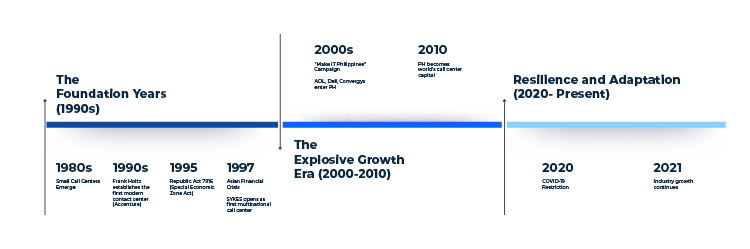
The Foundation Years (1990s)
Although small call centers for local clients existed in the 1980s, the Philippine BPO industry truly gained momentum in the early 2000s as international companies began recognizing the country’s strengths. What started as basic customer service support has since evolved into a multi-billion-dollar outsourcing powerhouse known worldwide for quality, efficiency, and reliable talent.
A key early milestone came in the 1990s when Frank Holz opened the country’s first modern contact center under Accenture. This helped set the stage for the fast growth of the Philippine outsourcing industry and highlighted the country’s ability to support global operations.
The groundwork for the Philippine BPO boom was laid in 1995 when President Fidel V. Ramos signed Republic Act No. 7916, the Special Economic Zone Act. This landmark legislation promoted foreign and local investments in economic zones, creating the regulatory framework and tax incentives that would attract multinational companies to establish operations in the Philippines.
In 1997, the Asian financial crisis unexpectedly accelerated this growth. As the peso weakened, the Philippines became an even more attractive low-cost outsourcing destination for Western companies looking to reduce operational expenses. That same year, SYKES opened as the country’s first multinational call center, showing that big international companies could successfully operate in the Philippines.
The Explosive Growth Era (2000-2010)
The early 2000s witnessed rapid expansion as major multinational brands established large-scale operations.
Between 2000 and 2004, Trade Secretary Mar Roxas launched the “Make IT Philippines” campaign, organizing the country’s first trade missions focused on IT-enabled services to the United States. This strategic initiative attracted the biggest global industry names to invest in the country, creating thousands of jobs for Filipino IT workers and establishing the Philippines as a serious contender in the global outsourcing market.
Companies like AOL, Dell, and Convergys established major operations in Metro Manila and Clark, Pampanga, drawn by the Philippines’ distinctive advantages: a highly skilled English-speaking workforce, strong cultural alignment with Western markets (particularly the United States due to historical ties), competitive labor costs, and a young, educated population eager for professional opportunities. These factors positioned the Philippines as the ideal hub for customer service outsourcing, technical support, and back-office operations.
By 2010, the Philippines officially surpassed India as the world’s call center capital, a distinction it continues to hold today. This remarkable achievement resulted from strategic positioning, continuous improvement in service quality standards, the natural communication strengths of Filipino workers, and their service-oriented culture. [Source: Bloomberg]
Resilience and Adaptation (2020-Present)
The COVID-19 pandemic in 2020 initially disrupted operations as companies scrambled to implement work-from-home arrangements for an industry traditionally centered in office environments. However, the sector demonstrated remarkable resilience during this challenging period.
Despite the economic turmoil, the sector added 23,000 full-time employees in 2020, bringing total headcount to 1.32 million, while posting revenue growth of 1.4% to reach $26.7 billion. This represented a rare rise in business during a year when most industries experienced record declines and the Philippine economy contracted by 9.6%.
The Philippine BPO industry stands as a testament to strategic vision and adaptability, having evolved from its humble beginnings into an indispensable component of the global business services landscape. [Source: ABS-CBN]
The current state of BPO in the Philippines
Today, the Philippine BPO industry stands as a cornerstone of the national economy and a global leader in outsourced services. The sector employs over 1.97 million Filipinos directly, with that figure growing month by month as many more benefiting indirectly through supporting industries. [Source: Inquirer]
The industry is expected to generate approximately $42 billion in annual revenue in 2026 [Source: Manila Standard]. This makes BPO one of the largest employment sectors in the Philippines, second only to agriculture. The economic impact extends beyond direct employment, stimulating real estate development, transportation, food service, and retail sectors in areas where BPO hubs operate.
While Metro Manila is still the main hub for BPO companies, the industry has expanded to major provincial cities like Clark, Cebu, Davao, Iloilo, Bacolod, and Baguio. This spread helps reduce concentration in the capital and brings economic opportunities to other regions.
The Philippines maintains several competitive advantages that sustain its leadership position. Filipino workers possess exceptional English proficiency, with the country ranking as one of the highest in Asia for English language skills. The cultural compatibility with Western markets, particularly the United States, enables Filipino customer service representatives to connect naturally with English-speaking customers.
Beyond call centers, the Philippine BPO industry has matured into higher-value services including knowledge process outsourcing (KPO), legal process outsourcing (LPO), healthcare information management, animation and creative services, software development, and financial analysis. This evolution reflects the industry’s move up the value chain, capturing more sophisticated and lucrative business segments.
The workforce is predominantly young, with an average age in the mid-20s to early 30s, bringing energy, adaptability, and technological savviness to operations. Educational institutions have aligned their curricula with industry needs, producing graduates with relevant skills in communication, IT, healthcare, finance, and other specialized areas.
Government Support & Policies that support the BPO industry
The Philippine government has recognized the BPO industry’s strategic importance and implemented comprehensive support mechanisms to ensure its continued growth and competitiveness.
The IT-BPO Roadmap 2022 (later extended and updated) serves as the government’s strategic blueprint for industry development. This roadmap focuses on developing talent, improving infrastructure, enhancing the business environment, and promoting innovation. It emphasizes moving beyond cost-based competition to value-based differentiation through skills upgrading and specialization.
Several government agencies play crucial roles in supporting the sector. The Department of Information and Communications Technology (DICT) leads policy formulation and infrastructure development for the digital economy. The Board of Investments (BOI) and Philippine Economic Zone Authority (PEZA) offer attractive investment incentives to qualifying BPO companies.
PEZA-registered enterprises enjoy significant tax benefits including income tax holidays ranging from 4-7 years, followed by a preferential 5% gross income tax rate in lieu of all national and local taxes. Companies also receive tax and duty-free importation of equipment, simplified customs procedures, and exemption from wharfage dues and export taxes.
The government has invested heavily in digital infrastructure to support BPO operations. Initiatives include expanding fiber optic networks to provincial areas, improving internet connectivity and speeds, developing IT parks and special economic zones with world-class facilities, and ensuring reliable power supply to critical BPO hubs.
Educational support comes through partnerships between government, industry, and academic institutions. Programs focus on curriculum development aligned with industry needs, training subsidies for new workers, and continuous upskilling initiatives for existing employees. The Technical Education and Skills Development Authority (TESDA) offers certification programs specific to BPO skills.
Recent legislative efforts have focused on data privacy protection, cybersecurity enhancement, and support for work-from-home arrangements. The Data Privacy Act of 2012 established standards that align with international requirements, giving clients confidence in the Philippines’ data handling capabilities.
Data security and Compliance
The National Privacy Commission enforces data privacy regulations, investigates breaches, and works with the BPO industry to establish best practices.
Reputable Philippine BPO companies implement layered security:
Physical controls: Biometric authentication, CCTV surveillance, secure zones for sensitive operations, personal device prohibitions in production areas
Technical controls: Encrypted transmission and storage, secure network architecture, regular security audits, multi-factor authentication, disaster recovery procedures
Operational policies: Employee background checks, non-disclosure agreements, role-based access limiting data exposure, security training, incident response procedures
Most reputable companies maintain certifications like ISO 27001 (information security), ISO 9001 (quality management), PCI DSS (payment card security), and HIPAA compliance (healthcare information).
Finding the Right Offshore Outsourcing Partner in the Philippines
Choosing the right BPO partner can determine the success or failure of your offshore strategy. Beyond pricing, businesses must evaluate factors such as data security, compliance, scalability, communication standards, and cultural alignment.
To help you make a confident, informed decision, we’ve created a practical guide: 10 Questions to Ask When Choosing a Philippines BPO Partner. This checklist walks you through the critical questions that uncover red flags, hidden risks, and long-term fit before you commit to a provider.
Step 01: Understanding Your Business Needs
Assessing your Business
A thorough evaluation of your business is crucial before considering offshore companies. This establishes clear criteria for selecting a suitable partner and clarify your business goals and unique needs. These are key aspects of finding an outsourcing partner who can align their goals with yours.
1. Identify Issues and Inefficiencies: Determine where problems or inefficiencies exist within your processes. Ask yourself:
a. Is there a gap in your processes?
b. Do you need specific expertise?
c. Are there resource constraints?
2. Evaluate Budget: Consider the budget you are willing to allocate for outsourcing. While you can reduce costs in the long run, offshoring would still require a good amount of investment upfront. Offshore companies offer a range of price models that could suit your financial plan. Consider all costs and expenses, both direct and indirect, to prevent perceived cost overruns.
Determining the Scope of Work
Distinguish the processes to offshore. Start by identifying your core business functions, which are the essential activities that directly contribute to your company’s primary mission and goals, and non-core activities, primarily support related tasks. Look at bottlenecks or gaps within your processes for non-core activity.
| Core vs Non-Core Activities Core Activities: Essential functions directly aligned with the organization’s mission and objectives. They create competitive advantage, drive profits, and enhance customer value by being unique and strategic to the business. Non-Core Activities: Supportive tasks that do not directly impact the organization’s core competencies. These include routine operations and support functions that are important but does not drive significant value or profits. |
The scope would also determine whether you need a more generalist offshore vendor or a specialist. If you require a vendor for one specific area of your operations a vendor specializing in that specific niche could offer your company high-quality expertise. Because they have a focused service, they are also nimbler and take less time to respond to unforeseen challenges.
But, if you’re offshoring more processes, a generalist vendor would be the best choice – not just for convenience but also cost-effectiveness. Their wide repertoire and expertise also make it easier for scaling your operations.
Step 02: Evaluating Expertise and Capabilities
Expertise and Technical Skills
After assessing your business needs, evaluate the technical skills and expertise of potential partners. Ensure they have the capability to meet your technical requirements and the knowledge to achieve your business goals.
Review their portfolios, check their history, or ask their clients to validate their skills and expertise.
When choosing a company, always look at projects or companies that have done work like yours. Look for examples of long partnerships between client and vendor as it is an excellent sign of credibility.
Reputation and Experience
Research the reputation and track record of potential offshore partners. Partnering with a company that has a poor reputation can negatively impact your business. The best way to verify their reputation is through client testimonials and references. You can also check out outsourcing dedicated directories like Outsourced Accelerator to provide you with a list of reputable companies that can offer you offshore services.
Check for any awards and certifications that validate their expertise and credibility. These accolades can provide additional assurance of their capabilities.
Infrastructure and Operations
Evaluating the infrastructure and operations of potential offshore partners is crucial to ensure they can support your business requirements effectively. Determine if the company has the capacity to scale operations as needed. This includes evaluating their staffing levels, management processes, and ability to handle increased workloads.
Assess their technological capabilities, including hardware, software, and network infrastructure. Ensure they have the latest technology and robust IT systems to handle your projects efficiently. Verify that the company adheres to relevant industry standards and best practices. This includes compliance with data security, quality management, and other pertinent regulations.
If possible, visit their office and check their operations in person. Observe the working environment, availability of necessary equipment, and overall organization of their workspace. By thoroughly evaluating the infrastructure and operations of potential offshore partners, you can ensure that they have the necessary resources and capabilities to support your business needs and contribute to the success of your outsourcing initiative.
Step 03: Cultural Fit
Every business has its own culture. To ensure a good fit with an offshore vendor, assess their work ethics, communication styles, decision-making processes, and attitudes toward hierarchy. Cultural compatibility enhances collaboration and reduces misunderstandings. Learn about how they approach deadlines, work-life balance, and conflict resolution to set realistic expectations and foster a productive working environment.
Bridging Cultural Difference
Although thorough research is essential, finding a perfectly compatible culture is challenging. Here are practical tips to help bridge cultural differences in your offshore partnership:
- Establish Clear Communication Standards: Set clear expectations for communication protocols, including regular updates, preferred communication channels, and response times. This ensures that both parties are aligned and can address any issues promptly.
- Utilize Online Tools: Make use of collaboration tools and platforms that facilitate seamless communication and project management. Tools like Slack, Zoom, and Asana can help bridge the gap caused by physical distance and different time zones.
- Educate About Each Other’s Culture: Invest in cultural training for both onshore and offshore teams. This helps team members understand and respect each other’s cultural backgrounds, reducing potential friction and enhancing mutual respect.
Step 04: Managing Transitions
The process does not stop after choosing an offshore provider. You will also need to manage transition. You must think about how to fit your new offshore team to your long-standing processes.
A well-organized transition ensures continuity, maintains productivity, and sets your offshore outsourcing journey to success. Take steps to minimize disruption during the transition. Clear communication and thorough planning are key to a smooth handover.
Manage Expectations
Managing expectations is essential to align goals and objectives between your team and the outsourcing partner. Clearly define the roles, responsibilities, and deliverables for both parties. Set realistic timelines and milestones to track progress. This alignment helps prevent misunderstandings and ensures that everyone is working towards the same outcomes.
Transparent and Honest Communication
Transparent communication is vital throughout the transition to build trust and ensure everyone is on the same page. Establish open lines of communication and encourage feedback from both your team and the outsourcing partner. Use collaborative tools and platforms to share updates, track progress, and resolve issues promptly. Transparent communication helps address concerns quickly and keeps the project moving forward smoothly.
Knowledge and Processes Transfer
Ensure effective knowledge transfer between your in-house and offshore team. This transfer is crucial for maintaining quality and consistency. Conduct training sessions, document processes thoroughly, and make sure your partner understands your business objectives and standards. Regular meetings and updates can help address any gaps in understanding and facilitate a smoother transition.
Continuous Improvement
Continue to monitor and evaluate performance throughout the transition period. It’s not going to be perfect from the start, but if you’ve properly managed the transitions, all that remains is to smoothen the edges.
Regularly review key performance indicators (KPIs) and gather feedback to identify areas for improvement. Implement changes as needed and celebrate milestones to maintain momentum and morale.
Doing the initial legwork not only makes the work easier in the long term but also helps you maximize the advantages of offshore outsourcing. By investing time and effort upfront, you can ensure a more seamless integration and better collaboration with your outsourcing partner. This proactive approach will help you achieve cost savings, increased efficiency, and improved service quality over time.
Conclusion
The Philippine BPO industry has evolved from a cost-driven call center sector into a sophisticated, globally competitive services industry offering high-value solutions across multiple domains. With strong government support, a talented and adaptable workforce, improving infrastructure, and a commitment to innovation, the Philippines is well-positioned to maintain and expand its leadership in global business process outsourcing.
For businesses considering outsourcing, the Philippines offers a compelling combination of cost efficiency, quality service delivery, cultural compatibility, and strategic advantages that few other countries can match. For Filipino workers and entrepreneurs, the BPO industry continues to provide employment opportunities, skills development, and pathways to economic advancement.
As the industry embraces artificial intelligence, automation, and digital transformation, the future promises even greater opportunities for those willing to adapt, learn, and innovate. The Philippines’ journey from emerging BPO destination to global leader demonstrates what vision, hard work, and strategic positioning can achieve in the modern global economy.
Start Your Outsourcing Journey in the Philippines
Ready to take the next step? Start your outsourcing journey in the Philippines with Offshore MVP. Our teams are not outsourced staff—they are Offshore MVP team members who work as an extension of your business, aligned to your culture, processes, and goals.
Talk to us today or send us a message to explore how outsourcing with MVP can support your growth.